The Renville County Court Calendar lists scheduled hearings, court dates, and case activity handled by the county court system. A jail roster, by comparison, shows people held in custody after booking, which explains why these two records serve different purposes. This page explains how court schedules work, how the judicial calendar is organized, and how hearing dates are set. It focuses on clear facts tied to court schedule data rather than custody status. Readers searching court activity often confuse booking records with hearings, which leads to missed details.
A court calendar reflects the official judicial calendar, showing when judges hear cases and when parties must appear in court. A jail roster reflects booking vs hearings, meaning custody records may exist without any listed court date, which is why Renville County Arrest Records often appear before a case is scheduled for court. This difference matters for people tracking case hearings, legal timelines, or upcoming appearances. Court schedules change based on filings, continuances, and courtroom availability. Clear separation between these records helps users find accurate hearing dates and case information without confusion.
What Is the Renville County Court Calendar
The Renville County Court Calendar is a public court schedule that shows when case hearings are set to take place. It helps people see upcoming court appearance dates tied to specific cases.
A simple explanation of the court calendar
The Renville County Court Calendar is a structured judicial calendar used to display planned case hearings on set dates and times. It lists basic scheduling details such as the hearing date, courtroom, and case reference. The calendar focuses on timing rather than results, giving a clear view of when a case is expected to appear before a judge. This setup helps court activity stay organized and predictable for everyone involved.
Who uses the Renville County Court Calendar and why
Many people rely on the court schedule for different reasons. Defendants check it to confirm court appearance dates. Attorneys review it to prepare for scheduled hearings. Court staff use it to coordinate courtroom activity, and members of the public may follow listed cases for awareness. Each group depends on the same calendar, which supports transparency and reduces confusion around hearing times.
How scheduled hearings appear on the calendar
Scheduled hearings appear as dated entries within the court calendar. Each listing reflects a planned step in a legal case, such as an initial appearance, motion hearing, or review session. Criminal, civil, traffic, and family matters may appear on different days based on court planning. Since court schedules can change, checking the calendar close to the hearing date helps confirm accurate timing.
What Is a Jail Roster and How Does It Work
A jail roster is a public list that shows who is currently held at a jail facility. It focuses on custody details rather than court outcomes or future hearings. A jail roster serves as a snapshot of custody status at a specific time. It pulls data from detention records created after an arrest and booking process. These records usually display a person’s name, booking date, charges at intake, and current booking status. Law enforcement staff update the roster as people enter or leave custody, so the information can change within hours.
Purpose of a Jail Roster
The main role of a jail roster is to report arrest information and custody placement. It helps the public confirm whether someone is held at the jail and under what initial charges. Families, employers, and legal contacts often check this list to verify detention status.
Found on a jail roster include:
- Full name and age
- Booking date and time
- Arresting agency
- Current housing status
- Bail or hold information
The roster does not explain case results. It only reflects what happened at booking.
Booking vs Hearings: Where Confusion Starts
Many readers mix up booking vs hearings, though both serve different roles. Booking happens right after an arrest. Staff record personal data, fingerprints, charges, and custody details. This step places a person on the jail roster. Court hearings take place later. They appear on a court calendar rather than a jail roster. This difference explains why inmate vs court cases often do not match. A person may appear on the jail roster without any scheduled hearing yet. At the same time, a court case may exist even after release from custody.
Distinctions include:
- Booking reflects custody status
- Hearings reflect court activity
- Jail rosters track detention
- Court calendars track legal dates
By separating detention records from court schedules, readers can avoid common mix-ups. This clarity helps users read jail rosters with realistic expectations and less stress.
Jail Roster vs Court Calendar: Differences
The jail roster and the court calendar serve related but distinct purposes in Renville County. A jail roster lists current inmates and their booking details, while a court calendar schedules legal proceedings and hearing dates for cases in the judicial system. While both tools track legal activity, they operate independently. The jail roster focuses on who is physically detained, whereas the court calendar outlines the timing of case hearings and courtroom schedules. This distinction often confuses family members, attorneys, and the public.
How the Jail Roster Works
The jail roster provides a daily snapshot of individuals currently held at Renville County Jail.
Each entry typically includes:
- Inmate name and ID number
- Booking date and time
- Charges or offense type
- Bond or release status
Because the roster reflects booking information, it updates frequently as inmates are admitted or released. An individual may appear on the jail roster even if their case has not yet been scheduled in court. Conversely, someone with a scheduled court hearing might not be listed on the jail roster if they have been released or are awaiting trial under supervision.
The Court Calendar
The court calendar tracks upcoming hearings, trials, and other legal proceedings.
It includes:
- Hearing dates
- Case numbers
- Assigned judges
- Courtroom locations
Court calendars are organized by scheduled hearings and case type rather than physical detention status. An inmate may have multiple court appearances while remaining in jail or may appear in court while under temporary release. Using the court calendar allows attorneys, family members, and the public to monitor case hearings and judicial schedules, providing clarity on legal progress even if someone is not actively listed in the jail roster.
Differences Between Jail Rosters and Court Calendars
| Feature | Jail Roster | Court Calendar |
|---|---|---|
| Primary Purpose | Tracks who is detained | Tracks scheduled hearings and court dates |
| Updates | Real-time for bookings/releases | Scheduled updates for court sessions |
| Information Displayed | Inmate name, booking date, charges, bond | Case number, hearing date/time, judge, courtroom |
| Legal Relevance | Reflects detention status | Reflects legal process timing |
| Public Use | Quick lookup of current inmates | Planning for court appearances, attorney prep |
Tracking Court Hearings and Case Timelines
The Renville County court schedule outlines all hearings, from arraignments to trials. Legal timelines provide a clear order of events, helping track a case from initial booking through each stage of the judicial process. The Renville County court calendar organizes case hearings so that defendants, attorneys, and the public know exactly when each matter will be addressed. These scheduled court dates help ensure hearings proceed efficiently and reduce confusion or missed appearances.
Steps in the Court Timeline
- Booking and Initial Processing
After an individual is booked into the Renville County Jail, their information is entered into the system. This step includes basic intake, fingerprinting, and initial scheduling for upcoming hearings, forming the first part of the legal timeline. - Arraignments
Arrangements happen soon after booking. During this hearing, defendants are formally charged, informed of their rights, and asked to enter a plea. Arraignments are often the first scheduled case hearings in the official court schedule. - Pretrial Hearings
Pretrial hearings review motions, bail, and procedural matters before a trial. These scheduled court dates are important for setting deadlines, exchanging evidence, and preparing for trial. Court officials post these dates in advance to give all parties adequate notice. - Trial and Subsequent Proceedings
Trials follow the court schedule and may include multiple hearings, witness testimony, or motions. Delays can occur due to unavailable judges, conflicting schedules, or court backlog. Each step in the legal timeline ensures that cases move through the system in order.
Factors That Influence Court Scheduling
- Case Type: Criminal, civil, traffic, or family court can affect timing
- Judge Availability: Courtrooms and judges may have conflicting schedules
- Holidays or Emergencies: Court closures can shift scheduled court dates
- Continuances: Attorneys may request delays for preparation
- High Caseloads: Backlogs can push hearings to later dates
These factors explain why some case hearings may appear delayed or rescheduled.
How to Monitor the Court Schedule
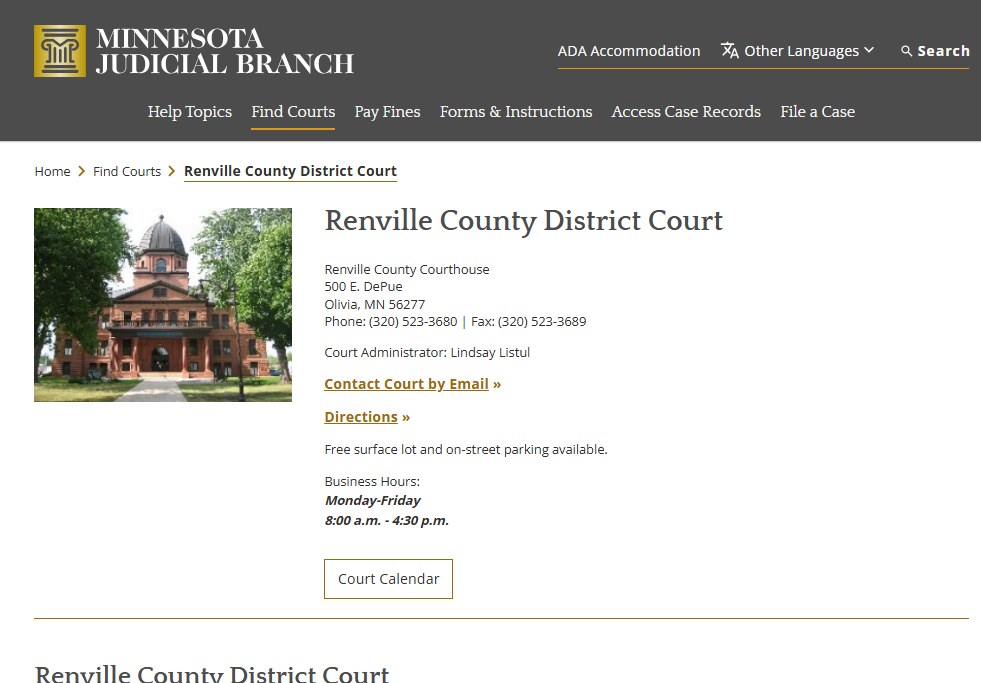
Individuals can track their scheduled court dates and access up-to-date hearing information using the official Renville County tool:
- Official Court Calendar Page: Renville County District Court – Court Calendar Info
https://mncourts.gov/find-courts/renville
- Check daily court calendar PDFs for exact hearing times
- Note that pretrial hearings and arraignments often occur within the first few days after booking
- Keep in mind that court schedules may adjust to meet procedural needs
Types of Cases Listed on the Court Calendar
The Renville County Court Calendar shows the schedule for all types of case hearings in the county. It lists criminal, civil, traffic, and family cases, allowing residents, attorneys, and other interested parties to stay informed about upcoming hearings. Each entry on the calendar includes key details such as case numbers, parties involved, courtroom assignments, and hearing times, helping users track case progress effectively.
Criminal Hearings
Criminal hearings are for cases where someone is charged with a violation of state law. These hearings include arraignments, pretrial discussions, and trial dates. Public Fingerprint Services may be used during the pretrial process for identity verification and background checks. Arraignments are when defendants are formally charged and asked to enter a plea. Pretrial hearings involve discussions about motions, evidence, or possible plea agreements. Trial dates are scheduled for the judge or jury to hear the case. These hearings are generally high priority because they involve public safety, and the calendar may update them frequently if hearings are rescheduled or postponed.
Civil Cases
Civil cases involve disputes between people, businesses, or organizations that do not involve criminal charges. Examples include property disputes, contract disagreements, small claims cases, or requests for monetary damages. On the court calendar, civil hearings are listed with the same level of detail as criminal cases, including hearing times, courtroom locations, and case numbers. While civil hearings often have flexible timelines, the calendar ensures transparency so that parties can prepare accordingly.
Traffic Court
Traffic court hearings are included for individuals charged with moving violations, driving under the influence, or other motor vehicle infractions.
The calendar may include:
- Ticket hearings
- License suspension appeals
- Traffic violation trials
Traffic cases are often shorter and scheduled more frequently than criminal trials, making it easier for individuals to track hearing dates in advance.
Family Court
Family court cases cover legal matters related to children, marriages, and domestic issues.
The calendar may show:
- Custody hearings
- Divorce proceedings
- Child support or visitation disputes
- Protective order requests
Family court hearings often involve sensitive matters. The calendar may note confidentiality where required.
How to Access the Court Calendar
- Official Court Website: Visit https://www.mncourts.gov, then select Find Courts → Renville County → Court Calendar.
- Google Search Operator: Enter:
site:mncourts.gov "Renville County Court Calendar"This helps find the live calendar page even if the previous URL is outdated. - Court Clerk Contact: Call or email the court clerk to confirm the latest PDF calendars or schedules.
How Cases Appear on the Calendar
Each case hearing is listed with essential details:
- Case number: Helps identify the case in the system.
- Parties involved: Typically includes the plaintiff and defendant or petitioner and respondent.
- Judge or courtroom assignment: Indicates where the hearing will take place.
- Date and time: Ensures participants know when to appear.
The Renville County Court Calendar updates regularly to reflect changes, including rescheduled hearings or cancellations. By presenting these criminal, civil, traffic, and family hearings clearly, the calendar helps residents, attorneys, and other stakeholders plan accordingly and stay informed.
Daily Court Calendar PDF Explained
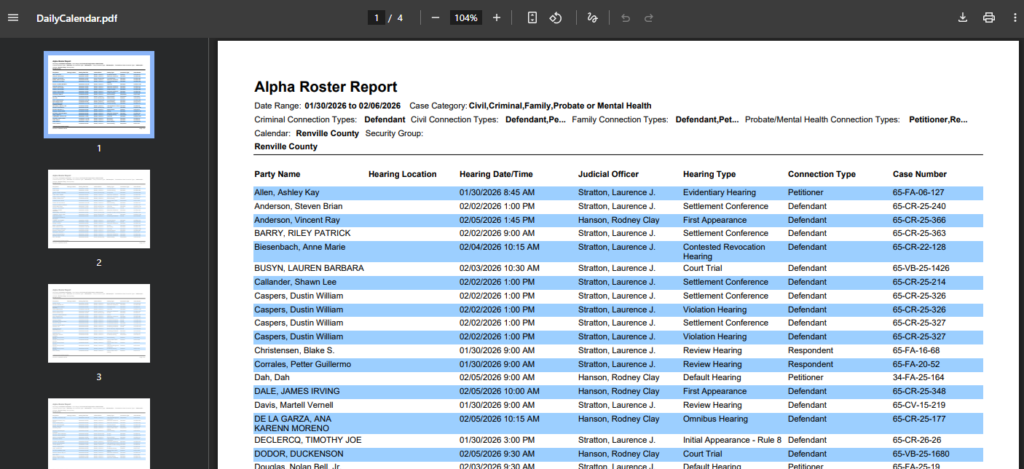
A daily court calendar PDF shows all scheduled hearings, times, courtroom locations, and assigned judicial officers for Renville County District Court. It provides a clear snapshot of the court docket in a format that can be searched or printed for easy reference. Most county court calendars, including Renville’s, are published in a searchable PDF format that users can open on computers or mobile devices. These documents are updated regularly during court business hours and list scheduled hearings for civil, criminal, traffic, family, and other case types.
How the Daily Court Calendar PDF Is Organized
A typical daily court calendar PDF is laid out in table form so users can scan hearing information quickly.
Expect to see the following columns:
- Case Number: A unique docket number for each matter.
- Case Type: Indicates category such as criminal, civil, or traffic.
- Party Names: The names of the people involved in the proceeding.
- Hearing Time: When the hearing is scheduled to begin.
- Courtroom / Location: Where the hearing will take place.
- Judicial Officer: The judge or magistrate assigned to the hearing.
This layout resembles a judicial calendar or hearing schedule, making it easier to find specific cases without scrolling through long blocks of text.
- You can download or view the Renville County daily court calendar PDF via the official court system here:
- Renville County Daily Court Calendar PDF (searchable)
- https://mncourtsdocs.courts.state.mn.us/Documents/Calendars/8/renville/DailyCalendar.pdf
Common Abbreviations and How to Read Them
Court calendars use short codes to save space. Recognizing these helps users interpret the court schedule:
- CR – Criminal case
- CV – Civil case
- TR – Traffic case
- FAM – Family court matter
- ARR – Arraignment hearing
- PTC – Pretrial conference
- CONF – Status or conference hearing
Reading with these abbreviations makes scanning the PDF faster, especially when checking multiple hearings or dates.
How to Find Hearing Dates and Court Appearances
Finding hearing dates and court appearances at Renville County is straightforward when the right resources are used. Individuals can search by name, case number, or scheduled date to locate accurate court information quickly. To begin, the Renville County Court maintains an official court calendar that lists upcoming hearings for all case types, including criminal, civil, and traffic cases. This calendar is updated regularly to reflect changes such as rescheduled hearings or new case entries. Court appearance dates can be confirmed by checking this calendar online or contacting the court clerk’s office directly. For individuals tracking multiple cases, using a case number can help narrow the search efficiently.
Searching by Name, Case Number, or Date
When looking for specific hearings, users can employ one of several methods:
- Name Search: Enter the full legal name of the defendant or party involved. This method works well for small cases but may return multiple results for common names.
- Case Number: Each court case is assigned a unique number. Using this number provides the most precise results and reduces the chance of confusion.
- Scheduled Date: If the hearing date is known, filtering the calendar by date helps locate all cases set for that day. This is useful for attorneys, family members, or anyone following multiple hearings.
It is recommended to check the daily court calendar PDF, which often lists hearings by time, courtroom, and judge. These PDFs also provide a snapshot of all scheduled hearings for the day and can be downloaded or printed for reference.
Why Someone May Appear on a Jail Roster but Not a Court Calendar
Some individuals may appear on a jail roster but not be listed on a court calendar because their case is still in the early stages of legal processing or because the court date has not yet been scheduled. Booking vs hearings differences often create this temporary discrepancy between detention records and official court schedules. When someone is booked into Renville County Jail, their name immediately appears on the jail roster. The roster reflects current inmate status, including newly admitted individuals, charges, and booking dates. However, being on a roster does not automatically mean that a court date has been assigned. Court calendars only list scheduled hearings that have been formally set by a judge, which can take several days or weeks after the initial booking.
Legal Processing Delays
Legal processing delays are a common reason for the mismatch between rosters and court calendars. After booking, jail staff submit case information to the court system. The court then reviews the charges and sets an initial hearing date.
During this process, the following may occur:
- Pending case review: Prosecutors may still be evaluating charges.
- Documentation processing: Court clerks require complete arrest reports and booking data.
- Scheduling constraints: Limited courtroom availability or judge assignments can delay the initial hearing.
These factors mean a person can remain on the jail roster for several days before appearing on the court calendar, even though legal proceedings are officially underway.
Court Scheduling Differences
Court schedules are organized to balance multiple cases efficiently. Some scheduling factors include:
- Case type: Criminal, civil, traffic, or family cases have different calendars.
- Hearing type: Initial appearances, arraignments, or pretrial hearings are often set separately.
- Judge availability: Court calendars are structured based on available judicial resources.
Because of these variables, it is common to see individuals on a jail roster without corresponding entries on the court calendar. This is a normal part of the judicial process and does not indicate an error or omission.
Court Calendar Updates, Changes, and Delays
Court schedules at Renville County can change frequently, and hearing dates may be rescheduled due to a variety of factors. Individuals checking the court calendar should expect occasional updates and adjust their plans accordingly. The Renville County court schedule is updated regularly to reflect new hearings, cancellations, and rescheduled cases. Court officials may postpone hearings due to judge availability, case conflicts, or unforeseen circumstances such as emergencies or public holidays. These updates are reflected on the official court calendar, which serves as the most reliable source for hearing dates.
Reasons Court Dates May Change
Several factors can lead to changes in the court calendar:
- Judge or courtroom availability: Sometimes hearings are moved to different dates or rooms.
- Case rescheduling requests: Attorneys or defendants may request postponements for valid reasons.
- Administrative delays: Clerical errors, document processing, or scheduling conflicts can affect hearings.
- Emergencies or closures: Severe weather or other urgent situations can temporarily close courtrooms.
Each update is typically posted as soon as the court processes the change, ensuring that the judicial calendar remains accurate. Individuals are encouraged to check the calendar regularly for rescheduled hearings and notice of any modifications.
How to Track Court Calendar Updates
Keeping track of updates can prevent missed hearings. The following strategies are effective:
- Check the official Renville County court calendar daily for any modifications in hearing dates.
- Sign up for notifications or alerts if the court offers an email or SMS update service.
- Contact the court clerk for confirmation, especially if a hearing is critical or time-sensitive.
- Keep a personal schedule aligned with the official calendar to avoid conflicts or missed dates.
By using these methods, individuals can stay informed about all court updates and maintain awareness of their scheduled hearings.
(FAQ) About Renville County Court Calendar
The Renville County Court Calendar is a public schedule that lists upcoming court hearings and case dates, helping individuals track legal proceedings. People can check court dates online or through courthouse resources to verify scheduled appearances and ensure compliance with judicial timelines.
What Is a Court Calendar?
A court calendar is an organized record of scheduled hearings, trials, and judicial proceedings in Renville County, showing details such as case numbers, parties involved, judge assignments, and courtroom locations. It covers civil, criminal, traffic, and family cases, providing a clear view of upcoming case hearings, and allows the public, attorneys, and involved parties to monitor court schedules and plan accordingly.
How to Check Court Dates
Court dates in Renville County can be checked through the official courthouse website or by visiting the courthouse in person, and daily court calendar PDFs provide an additional way to review scheduled hearings. Individuals can search using case numbers, party names, or hearing types, while cross-referencing with the official schedule ensures accuracy and reduces the risk of missing appearances or misunderstanding the legal timeline.
Is This Court Calendar Official?
While the Renville County Court Calendar provides accurate information about scheduled hearings, it is considered informational and should be verified with the courthouse for official records. The calendar reflects upcoming court dates and case hearings, but is not a legal document for filing motions or making official representations, so users should confirm any critical information with court staff to stay aligned with actual judicial proceedings.
Why Someone May Not Appear on the Court Calendar
A name may appear on a jail roster but not on the court calendar because hearings can be postponed, sealed, or not yet scheduled, and different systems maintain separate records for booking and legal proceedings. Understanding these differences helps individuals avoid confusion and ensures they track the correct legal timelines for their cases, whether for civil, criminal, or traffic matters.
How Often Is the Court Calendar Updated
The Renville County Court Calendar is updated regularly to reflect rescheduled, canceled, or newly scheduled hearings, with some divisions updating daily while others refresh weekly. Staying aware of these updates ensures that individuals are informed of changes in case hearings and can accurately follow the judicial calendar to avoid missed court appearances.