The Renville County Jail roster is a publicly available custody list that displays people currently held at the county detention center. It reflects active jail population data, including booking status and housing information, and changes as inmates are admitted or released. This roster helps confirm whether a person is in custody at the Renville County Jail. It focuses on the present detention status rather than past law enforcement activity. The information supports transparency while limiting sensitive details. The roster updates frequently to reflect real-time custody changes. It does not confirm guilt or court outcomes. Each entry represents temporary detention status only.
People search the Renville County jail roster to verify custody status, confirm recent booking records, or locate someone inside the detention center. Families, attorneys, and community members rely on the roster for timely jail population updates. It differs from arrest records, which may exist even after release or transfer. The roster only reflects individuals currently in custody. An inmate lookup builds on this list by allowing name-based searches tied to active jail records. This search method reduces confusion during urgent situations. It helps users avoid outdated arrest information. The focus remains on current detention center records.
Renville County Jail Facility and Operations
Renville County Jail serves as the county’s primary detention center, operated under the authority of the Sheriff’s Office. It houses people arrested across the county while supporting safe custody, supervision, and structured inmate housing. Renville County Jail operates as a secure correctional facility with a clear public safety role. The Sheriff’s Office carries the legal duty to manage daily operations, staffing, and inmate care. This responsibility includes maintaining order, supervising custody, and coordinating with local agencies across the county.
Sheriff’s Role in Jail Administration
The Sheriff’s Office oversees jail administration and sets operational standards for the facility. This role covers intake procedures, inmate supervision, and coordination with courts and law enforcement agencies. Corrections staff work under established policies that focus on safety, accountability, and orderly operations.
Daily management includes:
- Monitoring inmate custody status
- Supervising housing units
- Managing booking records and releases
- Coordinating with city police departments
This structure allows the detention center to function as a central holding location for county-wide arrests.
Facility History and Capacity
The current Renville County Jail opened in 2008 to replace older detention spaces. The modern design supports controlled movement, clear sightlines, and organized inmate housing. The facility has a 72-bed capacity, which helps manage short-term and pretrial populations.
Housing assignments depend on several factors:
- Custody status
- Classification level
- Safety and separation needs
This approach supports orderly housing and reduces operational strain on jail staff.
Who Is Housed at Renville County Jail
Renville County Jail houses people arrested anywhere within the county. This includes arrests made by:
- The Renville County Sheriff’s Office
- City and local police departments
People remain in jail regardless of which agency made the arrest. Many stay for short periods before court appearances, transfer, or release. The jail population may change daily as booking records update and custody decisions occur.
County-Wide Arrest Coverage
The jail serves the entire county rather than a single city. This county-wide role centralizes detention services and improves coordination between agencies. City departments rely on the correctional facility for secure holding, which supports consistent custody standards across jurisdictions.
How to Use the Renville County Inmate Lookup
The Renville County inmate lookup helps people check who is currently held at the county detention center. It shows booking records and custody details tied to recent arrests. The inmate lookup works through the official jail inmate list https://www.renvillecountymn.gov/sheriff/public-awareness/inmate-list/ published by the Sheriff’s Office. This offender search reflects current jail population data and updates as custody status changes.
Steps Process to Search Inmates
The Renville County inmate lookup uses a public-facing search tool connected to jail booking records. Most users complete a search in just a few minutes.
To search the jail roster correctly, users follow these steps:
- Visit the official inmate list page linked above.
- Review the alphabetical custody list shown on the page.
- Locate the inmate by full legal name or recent booking entry.
- Match the name with booking records, such as arrest date or charge.
Since the roster refreshes frequently, checking back later may show new entries added after the booking is completed.
Details Shown in the Inmate Lookup Results
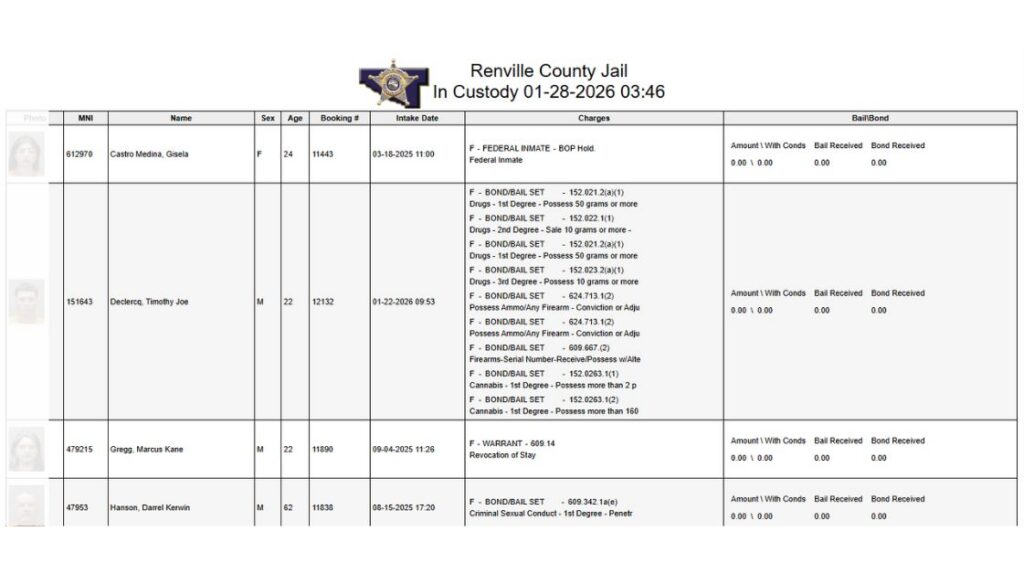
Each inmate record displays basic booking and detention center details. These records help confirm custody status without confusion.
Information commonly shown includes:
- Inmate’s full name
- Booking date and time
- Current custody status
- Primary charges at booking
- Assigned housing unit within the jail
Bond or release notes may appear if they apply. Records change as inmates move through the booking or release process.
Name Search vs Booking Number Search
The Renville County jail roster mainly supports name-based offender search. This method works best when the correct spelling of the inmate’s legal name is known. Booking number searches may appear on paperwork issued at the time of arrest or court intake. When available, a booking number links directly to a single custody record, reducing confusion caused by common names.
What to Do If an Inmate Does Not Appear
An inmate may not appear right away on the jail roster. Booking records often take time to post after an arrest.
If no record is found, users can:
- Recheck the name spelling
- Wait a few hours for processing
- Confirm the arrest occurred in Renville County
- Contact the jail for direct confirmation
Transfers, releases, or medical holds may remove an inmate from the active custody list. The inmate lookup only reflects current detention center housing, not past arrest history.
How the Renville County Jail Roster Works
A jail roster explains who is currently held at a detention center and why they are there. The Renville jail inmate list serves as a public record that shows basic custody details in one place.
What Information a Jail Roster Provides
A jail roster acts as a custody list that reflects daily booking activity at the facility. It helps readers see who is being held and what stage of custody applies.
Most jail rosters display:
- Full legal name of the person in custody
- Booking or intake date
- Current charges or case description
- Custody status, such as held, released, or transferred
- Housing location within the jail
This information gives families, legal contacts, and the public a clear snapshot of the jail population at a specific point in time. At the same time, details remain limited to protect safety and privacy.
Why Jail Rosters Change Daily
The Renville jail inmate list updates often since jail populations shift every day. Arrests, court decisions, releases, and transfers all affect who appears on the list.
Common reasons for daily changes include:
- New bookings after arrests
- Release after posting bond
- Court-ordered transfers
- Sentenced to another facility
For this reason, a name may appear one day and disappear the next. A missing name does not always mean an error.
Transparency and Public Availability
Jail rosters support transparency by showing how a detention center operates. Public availability allows residents to stay informed about custody activity within the county. It also helps reduce confusion by offering a single reference point for inmate status. Law enforcement agencies share roster details to balance public awareness with facility safety. Sensitive data stays restricted to protect staff and those in custody.
Limits of Jail Roster Information
A jail roster does not replace court records or legal filings. It does not show the full case history, guilt, or future outcomes. Booking records reflect status at one moment and may change without notice.
Details Available on the Renville County Jail Roster
The Renville County Jail roster shows key booking records that help the public see who is currently held at the detention center. It lists identity details, custody status, and charge information in a clear, structured format. The jail roster works as a public record snapshot. It reflects booking activity, housing placement, and custody details at a given time. Each entry follows a standard format so readers can quickly review important facts without confusion.
Full Name and Personal Identification
Every roster entry begins with the full legal name of the person in custody. This name usually matches the identity used during the arrest and intake process. Middle names or initials may appear if recorded at booking. This detail helps avoid mix-ups between people with similar names. It also supports accurate record searches when reviewing booking records or custody lists. Name spelling comes directly from the intake documentation completed at the detention center.
Booking Date and Arrest Timeline
The booking date shows when the individual was formally processed into the jail. This date often follows the arrest within a short time window.
Booking dates help readers:
- Track how long someone has been held
- Match custody records with court activity
- Confirm recent arrest activity in the county
Booking records may change if someone transfers, posts bond, or receives a release order.
Charges Listed on the Jail Roster
Each roster entry includes the charges connected to the booking. Charges reflect alleged violations recorded at intake, not final court outcomes.
Common charge details include:
- Statute or offense description
- Level of charge, such as misdemeanor or felony
- Multiple charges tied to one booking
Charge listings help readers see why someone entered custody. Court decisions may later update or dismiss these charges.
Custody Status and Current Standing
The custody status shows whether a person remains held, awaits transfer, or has a pending release. Status labels change based on court actions, bond posting, or administrative updates.
Typical custody terms may include:
- In custody
- Released
- Held pending court appearance
Custody status gives a quick view of the person’s current standing inside the jail population.
Housing Location Inside the Jail
Roster entries often note a housing location within the facility. Housing assignments depend on safety needs, population levels, and classification reviews.
Housing details:
- Help staff manage inmate movement
- Reflect security or medical needs
- Change during the stay if conditions shift
Housing labels remain internal references rather than public visitation instructions.
Bond Information at a High Level
Bond details appear when applicable. This section may list a bond amount or note eligibility for release.
Bond information typically shows:
- Amount set by the court
- Bond type, if available
- Status of bond posting
Bond records provide a basic financial reference. Courts control final release decisions tied to bond activity.
Booking and Intake Process at Renville County Jail
The booking and intake process at Renville County Jail explains how a person moves from arrest into jail housing while official booking records are created. This structured intake system supports inmate processing, safety checks, and housing placement inside the detention center.
Arrest, Intake, and Classification
After an arrest in Renville County, the individual is transported to the jail, where intake begins. During this stage, staff confirm identity, document charges, assign a booking number, and enter details into jail systems. Once intake is complete, classification reviews charge type, custody history, and behavior to decide supervision level and initial placement within the jail population.
Medical Screening and Health Review
Medical screening takes place early in the intake process to identify health concerns that could affect custody or safety. Staff review medications, injuries, mental health indicators, and withdrawal risks through a standard health questionnaire. Any medical needs are handled through internal procedures, and health details remain separate from public booking records and custody lists.
Property Handling and Personal Belongings
Property handling occurs after intake and screening to protect personal items during custody. Jail staff collect, inventory, and securely store belongings such as wallets, phones, and jewelry until release. A property receipt becomes part of the inmate’s booking file, while approved items may remain with the inmate based on detention center rules.
Initial Housing Decisions and Placement
Housing placement follows classification and health screening to support order and safety inside the facility. Staff consider custody level, medical needs, space limits, and current jail population before assigning housing. Placements may change if custody status updates, transfers occur, or booking records reflect new information during the inmate’s stay.
Inmate Housing, Population, and Jail Capacity
Renville County Jail operates as a 72-bed detention center that manages a changing jail population throughout the year. Inmate housing decisions reflect safety needs, custody status, and available facility capacity.
72-Bed Facility Capacity and Layout
Renville County Jail functions within a fixed 72-bed capacity, designed to support short-term detention and court-related holds. The detention center includes separate housing areas that support daily supervision, classification, and secure movement. The jail population may reach full capacity during busy arrest periods. At other times, the custody list shows fewer occupied beds. Capacity limits guide intake decisions and may influence temporary transfers if the jail population rises.
Facility capacity planning focuses on:
- Secure inmate housing areas
- Clear separation of custody levels
- Supervised living units
- Safe staff-to-inmate ratios
This structure supports booking records management and daily operations across the detention center.
Jail Population Changes and Housing Assignments
The jail population changes often, shaped by arrests, court releases, and scheduled transfers. Short stays may follow booking or court hearings. Longer stays may occur for sentencing or pretrial holds. Inmate housing assignments rely on classification reviews. These reviews consider custody status, behavior history, and safety risks. Housing units group inmates with similar needs to reduce conflict and improve supervision.
Common housing factors include:
- Gender separation
- Custody level placement
- Medical or mental health needs
- Temporary holding requirements
Safety Practices Inside the Detention Center
Safety remains central to housing decisions within the detention center. Staff monitor inmate movement, living areas, and common spaces throughout each shift. Housing placements change if safety concerns appear. Controlled housing assignments help protect inmates and staff. Clear procedures support order during intake, transfers, and daily routines. These measures allow the jail population to remain managed within approved facility capacity, even during higher-volume periods.
Inmate Programs and Rehabilitation Efforts
Renville County Jail provides structured programs designed to help inmates build skills, maintain accountability, and prepare for life after incarceration. These initiatives focus on education, personal development, and reintegration into the community.
Programming Philosophy and Educational Focus
The jail’s programming philosophy emphasizes that participation in constructive activities can significantly reduce recidivism and support rehabilitation. Inmates have access to educational courses, vocational training, and life skills workshops, all aimed at promoting personal growth. Education programs range from basic literacy classes to specialized courses in areas like computer literacy, financial management, and anger management. These programs help inmates develop competencies that increase employability and self-sufficiency once released.
Rehabilitation Goals and Structured Support
Rehabilitation goals at Renville County Jail include fostering responsibility, improving behavior, and encouraging accountability for past actions. Structured group activities, counseling sessions, and individualized plans ensure each inmate receives guidance suited to their unique needs. Officers collaborate with program coordinators to track progress and adjust activities, creating an environment that balances security with personal development.
Importance of Purposeful Engagement
Programs matter because they offer inmates purposeful engagement that reduces idle time and supports mental health. Vocational training such as carpentry, plumbing, or culinary skills, allows participants to acquire practical skills that can translate into legitimate employment opportunities post-release. Likewise, educational initiatives provide certificates or credentials that strengthen future job prospects and encourage lifelong learning.
Community Reintegration and Skill Development
Community reintegration is a core component of the jail’s rehabilitation strategy. Inmates learn conflict resolution, communication skills, and social responsibilities, which prepare them for safe and productive reentry into society. Structured release planning, mentorship programs, and collaboration with local support organizations further support this transition. By combining structured learning, personal growth initiatives, and practical skill-building, Renville County Jail’s programs aim to reduce repeat offenses and promote lasting positive change.
PREA Policy and Inmate Safety
The Renville County Jail strictly follows the Prison Rape Elimination Act (PREA) to ensure inmate safety and prevent sexual abuse within the facility. This policy creates clear procedures for reporting misconduct and defines the jail’s responsibilities toward all individuals in custody.
What PREA Is
PREA is a federal law aimed at eliminating sexual abuse and harassment in correctional facilities. It establishes national standards for prevention, detection, response, and accountability. At Renville County Jail, PREA ensures that all inmates are protected from abuse by staff or other inmates while maintaining a secure environment.
Why It Exists
The law exists to safeguard vulnerable populations and promote safe, humane detention. Inmates are often in situations where they cannot protect themselves fully, making oversight critical. Implementing PREA standards reduces incidents of abuse and reinforces public trust in the correctional system.
Reporting Misconduct
Inmates, staff, and visitors have multiple ways to report suspected abuse or misconduct. Reporting methods include confidential phone lines, written statements, and direct contact with trained officers. The jail prioritizes timely investigations and takes all allegations seriously, ensuring proper follow-up and protection for those who report.
Points for reporting:
- Confidentiality: Reports are handled discreetly to protect the reporter.
- Multiple channels: Phone, email, or in-person options are available.
- Prompt investigation: Allegations are assessed quickly with accountability measures.
Jail’s Responsibility
Renville County Jail staff are trained to prevent, identify, and respond to incidents under PREA guidelines. Responsibilities include:
- Conducting regular audits and inspections.
- Offering staff training on inmate rights and abuse prevention.
- Monitoring inmate interactions to minimize risk.
- Ensuring victims receive support and access to resources.
By following PREA, the jail promotes inmate safety, abuse prevention, and facility accountability. A secure environment reduces the likelihood of misconduct and reinforces a culture of respect within the detention center.
Visitation Rules and Visitor Information
Visiting an inmate at Renville County Jail requires following clear rules and procedures to ensure safety and security. Only approved individuals can participate in jail visits, and adherence to these rules is strictly enforced. Renville County Jail maintains structured visitation policies to balance public access with the safety of inmates and staff. Visitors must be pre-approved by jail administration before entering the facility. Typically, family members, close friends, and legal representatives are allowed, while anyone with a recent criminal record or unresolved legal issues may be denied access. All visitors are required to provide valid photo identification, such as a driver’s license or state ID, at the entrance.
General Rules for Visitation
- Visits are scheduled according to the jail’s established hours and may be limited in duration.
- Visitors must adhere to dress codes; revealing or inappropriate clothing is not allowed.
- Personal belongings, including bags and electronic devices, are prohibited in visitation areas.
- All visits may be monitored or recorded for security purposes.
- Any attempt to bring contraband can result in permanent visitation suspension or legal action.
Behavior Expectations During Jail Visits
Maintaining proper conduct is mandatory for all visitors. Disruptive behavior, physical contact beyond what is allowed, or disrespect toward jail staff can result in immediate termination of the visit. Visitors are encouraged to remain calm, speak respectfully, and follow all instructions from corrections officers. Children may be allowed to visit but must always be supervised by a responsible adult.
Identification and Verification
Before each visit, the jail verifies the visitor’s identity using government-issued identification. Visitors may be required to sign a log or waiver acknowledging the facility’s rules. Any discrepancy in identity or behavior can lead to denied entry. Legal representatives must also present credentials and may be subject to additional screening.
Inmate Mail, Phone Calls, and Communication
Inmate communication at Renville County Jail is structured to allow secure contact with loved ones while maintaining facility safety. Inmates can send and receive mail and make phone calls under controlled procedures.
All incoming and outgoing mail is screened for security purposes. Letters must include the full inmate name, booking number, and return address. Certain items are prohibited, including:
- Polymers, liquids, or perishable items
- Cash or unauthorized checks
- Threatening or inappropriate content
Legal correspondence with attorneys receives special handling and is not opened by jail staff. Mail may be delayed briefly for inspection, and envelopes or contents that violate rules are returned or discarded.
Phone Call Access
Inmates can make phone calls using the facility’s approved phone system. Calls are typically collect or prepaid, and inmates are responsible for following the scheduled times.
Key points include:
- Calls are monitored and recorded, except for privileged attorney communications
- Time limits may apply to ensure all inmates have access
- Family members should verify call rates and account setup before expecting calls
Monitoring Notices
All calls and mail are subject to monitoring to prevent contraband, threats, or illegal activity. Inmates are informed that communications are not private except when legally protected. Notices are clearly posted within the facility, and staff regularly review records to maintain safety.
Prohibited Content
Items or communications that may compromise safety, violate the law, or disrupt facility operations are not permitted.
Examples include:
- Threatening language or gang-related content
- Drugs, paraphernalia, or weapon-related material
- Contraband sent through the mail or phone
By following these rules, inmates maintain essential contact with family and legal representatives, supporting mental well-being and rehabilitation efforts. Mail rules, phone services, and monitoring procedures are all designed to balance communication needs with security requirements.
Public Fingerprint Services
Public fingerprint services provide a secure way to record and verify an individual’s unique fingerprint patterns. These services are commonly used for identity verification and background checks in various personal and professional contexts. Renville County offers public fingerprinting for residents who need official verification of their identity. These services are often required for employment purposes, volunteer work, licensing, or legal documentation. By using fingerprints, authorities can confirm identity accurately, reducing the risk of fraud or mistaken identity.
Who Needs Public Fingerprint Services
Individuals may need fingerprinting for several reasons:
- Employment screenings: Many employers require background checks for positions in childcare, education, or security.
- Licensing and certifications: Certain professions, such as healthcare or law enforcement, require official fingerprint verification.
- Volunteering or community work: Organizations often request fingerprints to ensure safety and accountability.
- Legal requirements: Fingerprints may be necessary for court orders, adoptions, or other official processes.
Public fingerprint services are accessible to a wide range of people, ensuring that anyone needing verification can complete the process safely and efficiently.
How Public Fingerprint Services Work
The general process for fingerprinting includes the following steps:
- Appointment or Walk-In: Individuals schedule an appointment or arrive at a designated location for fingerprinting.
- Identity Verification: A government-issued ID is required to confirm the individual’s identity before proceeding.
- Fingerprint Capture: Trained personnel use ink or digital scanners to capture the fingerprints. Digital methods are preferred for accuracy and immediate processing.
- Submission for Background Checks: Fingerprints are sent to the appropriate state or federal agency for verification or background screening.
- Record Storage: Copies of fingerprints are securely stored to prevent misuse while ensuring accessibility for official purposes.
This process ensures a reliable, secure, and standardized method for identity verification and background checks.
Victim Information and Notification Resources
Victims of crime in Renville County can access a range of information and notifications to stay informed and feel supported. These resources provide timely updates about offenders and ensure that victims are aware of relevant safety measures.
Victim Support
The Renville County Sheriff’s Office recognizes the importance of supporting victims throughout the criminal justice process. Victims are provided with resources that help them understand their rights, the status of criminal cases, and the availability of counseling or advocacy services. Local agencies collaborate to connect victims with support programs, including crisis counseling, legal assistance, and referral to community organizations. These services aim to reduce stress, increase safety, and provide guidance during challenging times.
Notification Programs
Notification systems in Renville County are designed to keep victims informed about offender status changes. Programs like VINE (Victim Information and Notification Everyday) allow victims to receive real-time updates on arrests, releases, or transfers. Registration for these programs is straightforward and can be done online or by phone. Alerts can be sent via text messages, email, or phone calls, ensuring that victims remain aware of developments without needing to constantly check themselves.
Key features include:
- Custody status alerts for offenders
- Scheduled release notifications
- Transfer updates between facilities
- Court hearing reminders
These systems provide transparency and empower victims to make informed decisions regarding their personal safety and planning.
Safety Awareness
Staying safe after a crime involves more than notifications. The Sheriff’s Office offers guidance on protective measures and community resources that victims can use to reduce risk. This includes instructions on restraining orders, emergency contacts, and local support networks. Victims are encouraged to report any concerns immediately and utilize law enforcement services when necessary. Awareness programs also educate the public about common scams, identity theft risks, and personal security practices, creating a safer environment for all residents.
Jail Roster vs Court Calendar vs Arrest Records
A jail roster, court calendar, and arrest records serve different purposes, even though they are all related to law enforcement and legal proceedings. Each provides specific information about individuals in the criminal justice system and may appear differently depending on timing and official reporting.
The Renville County Jail Roster
The jail roster lists individuals currently housed in the Renville County Jail. It shows basic details like full name, booking date, custody status, charges, and housing assignment. It is updated regularly to reflect new bookings, releases, and transfers. This makes it useful for family, legal representatives, and the public to see who is in custody at any given time.
Court Calendar Information
The court calendar details scheduled hearings, trials, and other legal proceedings. It does not indicate where an individual is housed or if they are currently in custody. Instead, it focuses on court events, including dates, times, and courtroom locations. Many people assume that a name on the court calendar automatically appears on the jail roster, but this is not always true. A defendant may have been released on bail, transferred to another facility, or not yet processed into the jail system.
Arrest Records Overview
Arrest records provide a snapshot of the arrest event itself. They usually include the arresting agency, date and time of arrest, charges filed, and sometimes mugshots. Arrest records can exist even if the person was never booked into jail or was quickly released. This explains why someone might appear in arrest records but not on the jail roster or court calendar.
Location & Directions to Renville County Jail
The Renville County Jail is located at 104 4th Street S., Olivia, MN 56277, providing a central location for residents and visitors throughout the county. It can be easily reached via major highways and local roads, with clear parking options and accessible facilities.
Visitors coming from Highway 212 or Highway 71 should follow signs toward downtown Olivia, then head south on 4th Street. The jail is positioned near local landmarks such as the Renville County Courthouse and nearby city parks, making it simple to locate. GPS coordinates for navigation are approximately 44.9000° N, 94.9000° W, ensuring accurate directions through mapping apps.
Parking and Accessibility
- Public parking is available directly in front of the facility and along adjacent streets.
- Spaces are designated for visitors, including accessible parking for those with disabilities.
- The main entrance has a ramp and automatic doors to support easy access.
Nearby Landmarks
- Renville County Courthouse – 2 blocks north
- City Hall – within a 5-minute walk
- Local parks and community centers – visible from main roads
This setup helps ensure that anyone visiting the Renville County Jail can locate the facility quickly and safely, with clear guidance on where to park and how to enter. Visitors are encouraged to plan their trip using local maps or GPS devices for the smoothest experience.
(FAQ) About the Renville County Jail Roster
The Renville County Jail roster is updated regularly to provide the most accurate information about current inmates. Users may occasionally encounter missing entries if updates are pending or an inmate was recently booked. This FAQ section answers common questions about how the roster works and what information it shows, helping readers avoid confusion and understand custody details clearly.
How often is the jail roster updated?
The Renville County Jail roster is refreshed on a daily basis to reflect changes in inmate status, including new bookings, releases, and transfers. Because updates depend on administrative processing, there may be short delays before recent changes appear online. This daily update schedule helps keep the custody list and overall jail population information as accurate as possible for families, attorneys, and the public.
Why can’t I find someone on the roster?
Someone may not appear on the jail roster if they were recently booked, transferred to another facility, or released shortly after arrest. In some cases, privacy or security limitations may prevent an inmate’s information from being displayed, or there may be temporary data entry delays. The roster only shows individuals currently in custody, so checking back later and using the correct legal name can improve search results.
Is the jail roster an official source?
The Renville County Jail roster is maintained by the Sheriff’s Office and reflects current inmate information available to the public. While it is considered a reliable source for custody status, it is intended for informational purposes only and does not replace official court documents or legal records. Users should verify important details through court offices or law enforcement agencies when formal confirmation is required.
Can inmates be released the same day they are booked?
Yes, some inmates may be released on the same day they are booked, depending on factors such as the type of charge, bail conditions, or court orders. Minor offenses, quick bond payments, or completed intake procedures can result in same-day release. These changes are usually reflected in the roster updates, although slight delays may occur due to processing timelines.
Does the jail roster show everyone who was arrested?
No, the jail roster only shows individuals who are currently housed in the Renville County Jail, not everyone who was arrested. Some people may be cited and released, transferred to another detention center, or released shortly after booking. Because of this, arrest records and court calendars may list names that do not appear on the jail roster, even though an arrest occurred.